Training and raising awareness about citizen science
3. Interactive session: Design your own training inside or outside your RPO
In this interactive session, learners will utilize the logic model to design a CS training program, either for internal stakeholders within their RPOs or for external audiences. Learners will have a clear, logic model-based plan for a CS training program. They will gain hands-on experience in applying a structured approach to training design. The session fosters collaboration, critical thinking, and practical application of theoretical knowledge in CS training development.
Module description:|
Program |
Task |
|
Introduction |
Briefly introduce the logic model as a tool for planning and evaluating CS training programs. Explain the session's objective: to create a structured plan for a CS training session. |
|
Group formation |
Divide learners into small groups or set them up to work individually. Provide each group or individual with a template of the logic model and necessary materials (pens, paper, or digital tools). |
|
Designing the training |
Learners use the logic model to develop their CS training plan. This involves identifying inputs (resources needed), activities (what will be done), outputs (immediate results), outcomes (short and long-term goals), and impacts (broader changes or benefits). Encourage creativity and practicality, considering factors like audience, content, resources, and desired outcomes. |
|
Sharing and feedback |
Each group or individual presents their logic model-based training plan. Encourage peer-to-peer feedback, focusing on the feasibility, clarity, and potential impact of each plan. |
|
Evaluation and conclusion |
Conclude the session by highlighting the importance of structured planning in effective training program design. If time allows, the facilitator can provide brief, overarching feedback, emphasizing key takeaways. |
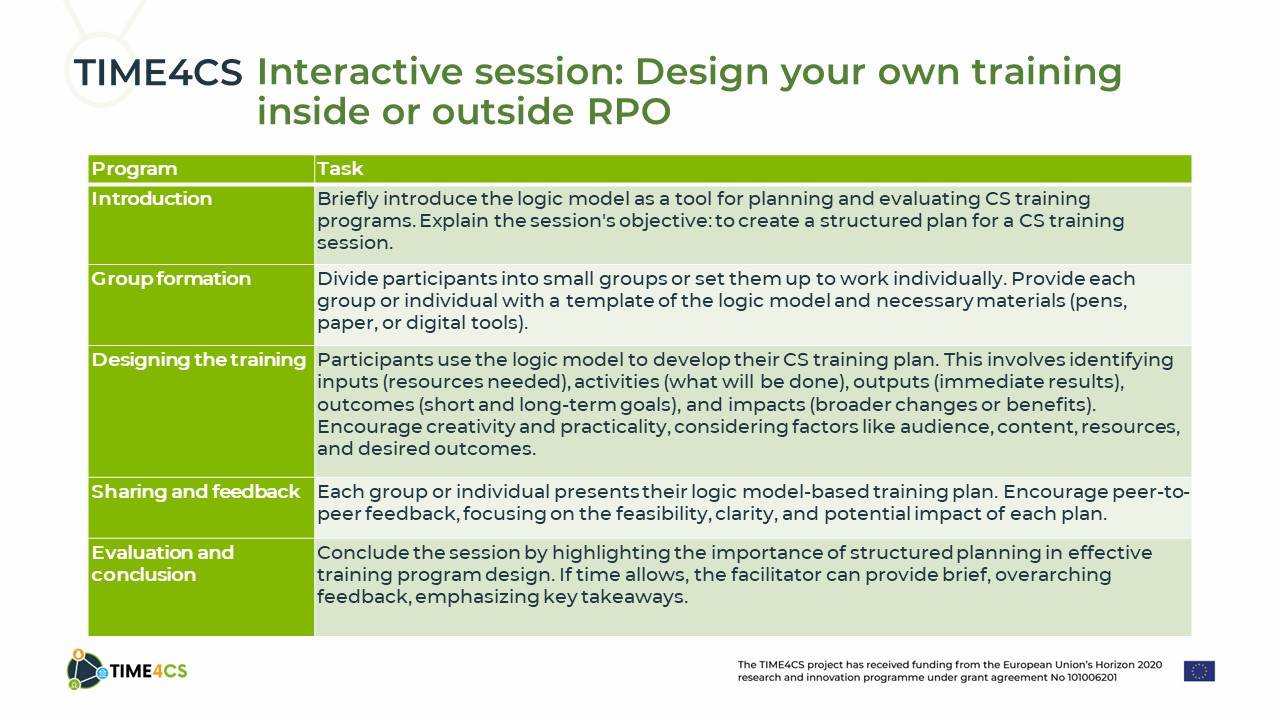
Slide (available in slide deck)